
 By Saurav Roy
Key Takeaways
- The feeling is genuine, but text can make it stronger than the evidence supports.
- Expect your mind to fill gaps with flattering guesses about them.
- Plan for a drop in romantic attraction at the first meeting.
- Ask direct questions and share personal details; both predict better first dates.
- Keep your in-person friendships going; online-only connections are linked to more loneliness.
- Missing them often means missing the version of them you’ve imagined.
- If they don’t feel the same, the pain is real and common, and distance helps.
- Treat any request for money from someone you haven’t met as a scam.
You have never heard their voice, yet their message is the first thing you check each morning, and you wonder if this can be love. You use text-only site, so every impression you have comes from words they chose and edited. The honest answer is yes, the feeling is genuine, and the harder question is what it’s attached to.
Communication professor Joseph Walther of the University of California, Santa Barbara, introduced the hyperpersonal model in 1996 to explain online communication that sometimes surpasses normal interpersonal levels.
Let’s find out how that model explains your feelings, how to test them before you meet, whether the relationship is healthy, why you might miss them, what to do if they don’t feel the same, and the one warning sign that should end the chat.
Can You Really Love Someone You’ve Never Seen?
Yes, and the research suggests it doesn’t mean you’re naive. Walther’s model predicts this, because text can feel warmer than face-to-face contact. Your pull toward this person is a reaction to the conversation you’ve had, so it is evidence about the conversation first and about them second. Research published by Antheunis, Schouten, and Walther supports that: text-based chat produced more social attraction than video chat in a speed-dating event with 39 people and 95 conversation pairings. After those pairs met face to face, social attraction held, but romantic attraction declined.
Why Does a Text-Only Chat Feel So Intense?
Walther’s model has four components: selective self-presentation, idealization, channel management, and feedback. The first and third explain much of the intensity. In a 2007 study, Walther examined how people managed composing time and editing in their first messages, so a message you receive is a draft the sender chose to send.

On a text-only site, every message you read is a final version, so you never see the false starts or the replies a person writes while distracted. I’d weigh the quick, unpolished replies more than the best paragraph, because quick replies show how they communicate when they aren’t composing an impression.
Are You Falling for Them or for the Gaps You’ve Filled In?
I’m wary of treating intensity as proof of compatibility, because the model explains intensity without needing a good match. The second component, idealization, describes what receivers do when cues are scarce: they assume the best about the sender. The fourth, feedback, then amplifies it, because you respond warmly to the person you imagine and that warmth encourages them to live up to the image. Before your next long conversation, check yourself with three questions:
- What have they shown me more than once?
- What am I assuming because it fits the person I want them to be?
- How did they handle the last time something didn’t go to plan?
What Happens When You Finally Meet?
Expect some disappointment, because Sharabi and Caughlin’s study of 94 online daters found most were less attracted after the first date than they had been online. The same study found that daters who asked more questions and shared more personal details had better first dates, as did those who felt similar to their partner. I’d use the chat to ask for specifics and share something personal in return, which likely narrows the gap between the imagined person and the one who shows up.
Is It Healthy to Love Someone You’ve Never Met?
It can be, but the research is less reassuring than the feeling, so I’d judge it by what it does to the rest of your life. A study of 6,646 people in relationships across 50 countries found that those who met their partners online reported lower relationship satisfaction and less intense love than those who met in person. The researchers stress the findings are correlational and don’t mean online relationships are doomed. I’d read it cautiously, because it compares how couples met and doesn’t speak directly to people who haven’t met yet.

Chat with strangers
from around the world
Random, anonymous, and instant — no sign-up required. Just click and start talking.
A second study comes closer to the never-met part. In a nationally representative survey of 1,514 US adults aged 30 to 70, people with a higher share of online-only connections reported more loneliness. The researchers suspect one reason is that social media makes misinterpretation easy. That study counted social media contacts in general, not romantic partners, and lonelier people may be the ones who seek out online strangers in the first place, so it can’t show that your chat is making you lonely.
Here is what I’d check:
- Respect: A healthy online relationship rests on mutual respect, honesty, and kindness, and the other person accepts it gracefully when you say no.
- Your wider life: The Oregon State researchers suggest lonely people put in-person connections first, even when online ones feel close. Ask whether this chat adds to your week or replaces the friends and plans you’d otherwise have.
Why Do You Miss Someone You’ve Never Met?
You may be missing the version of them you’ve built, along with the future you pictured. In a student-written Her Campus article, psychologist Karoline Miranda says longing without a relationship can be longing for the projection we place on someone. When we know little about a person, we fill the gaps with traits and scenarios we’d like to find, and in that fantasy the person never makes mistakes or disappoints us. That is Walther’s idealization in everyday terms. Miranda calls the result an unrecognized grief, because the pain is easy to dismiss when there was no formal relationship. The article adds that repeatedly checking their profile or activity for signs of interest keeps you on watch and makes distance harder.
The same article suggests two things that help: separate facts from projections by asking what they actually said and did, and redirect your attention toward relationships that offer presence and reciprocity. I’d start with the first, using the three questions above.
What If They Don’t Feel the Same Way?
Expect it to hurt, and don’t read the pain as proof you were foolish. Psychotherapist F. Diane Barth, writing in Psychology Today, cites University of Michigan research suggesting emotional pain activates the same brain region as physical pain.
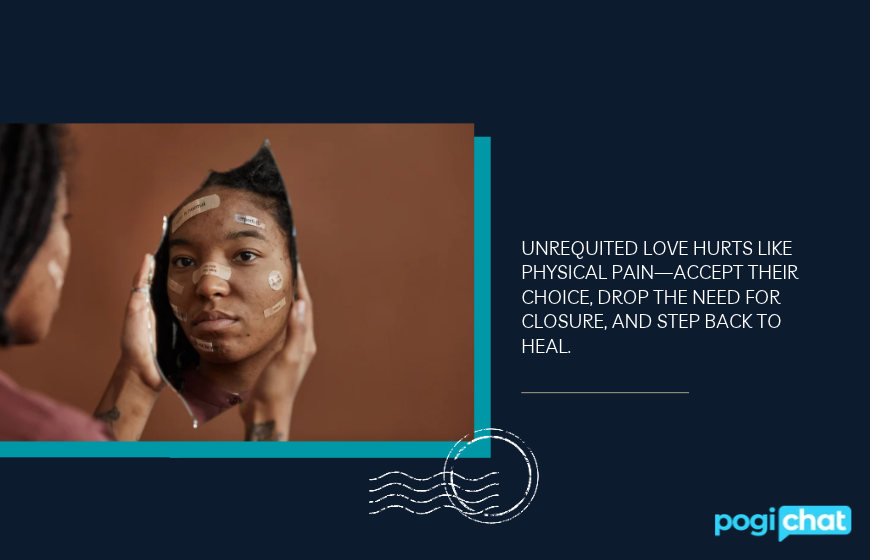
She also cites social psychologist Roy Baumeister’s estimate that 98% of people have experienced unrequited love, and notes that shame often arrives with the sadness. Her advice includes:
- Go easy on yourself at work or school rather than expecting peak performance.
- Ask whether falling for people who reject you is a pattern. She notes psychologist Phillip Shaver links this to insecure attachment for some people.
- Give up the quest for closure, either by accepting the pattern or by letting go without it.
Barth also reports that in Baumeister’s study of more than 200 incidents, the person who turned the love down often felt guilt and anxiety too. She admits that may not help much, but it can make it easier not to assume they were cruel.
On the practical side, the Her Campus article advises accepting that the other person is free not to reciprocate. BetterHelp lists physical distance, hobbies, and time with loved ones as ways to cope. On a text-only site, I’d read that as muting notifications or leaving the thread. The same page says talking to a therapist may give you skills for moving forward, which seems reasonable if this is affecting your sleep, work, or friendships. One caution: a warm reply that arrives with a request for money is a scam sign, not a change of heart.
When Does a Never-Met Romance Become a Warning Sign?
Genuine feelings and scams can look alike in the first weeks, so judge them by what the person asks you to do. According to the FTC, scammers say they can’t meet in person and then ask for money, with excuses such as living abroad or serving in the military. Its rule is plain: never send money or gifts to someone you haven’t met in person. Scammers create urgency so you pay quickly, and a rushed request for money is a reason to stop. If you suspect a scam, the FTC advises stopping contact and talking to someone you trust, and you can report it to the dating site.
READ MORE:
How to Chat Safely Online
Anonymous Chat Safety How to Talk to Strangers Securely
Is Giving Out Your Number on Dating Apps a Privacy Risk? What Every User Should Know
Feelings Are Valid, Evidence Comes Next
So, can you fall in love with someone you’ve never met? Yes, and Walther’s hyperpersonal model explains why text can feel more intimate than face-to-face contact: senders polish, receivers idealize, and the two of you reinforce the picture.
Whether it’s healthy depends on whether it adds to your life or replaces it, and if you miss them, part of what you miss may be the version you imagined. If they don’t feel the same, the hurt is common and real, and distance and time with people you know in person help.
Limits apply: the speed-dating, first-date, couples and loneliness studies involved particular groups, none of them studied exactly your situation, and Walther’s model describes tendencies, not your partner’s honesty or your future.
If anyone asks you for money before you meet, treat it as a scam, tell someone you trust, and report it to the dating site. So ask them one question that needs a specific story, because asking more questions was linked to better first dates in Sharabi and Caughlin’s study.
FAQs
Is It Normal to Have Feelings for Someone You’ve Never Met?
Yes, Walther’s model describes how text can become more intimate than face-to-face contact, and a speed-dating study found text chat produced more social attraction than video. The feeling is genuine, though it may attach to an idealized picture.
How Does Someone Fall in Love Without Seeing the Other Person?
Walther’s model points to four parts: senders show their best side, receivers fill gaps with flattering guesses, the channel gives time to edit, and feedback strengthens the pull as you respond to each other.
Is It Healthy to Love Someone You’ve Never Met?
It can be, if the relationship is respectful and honest and doesn’t push out your in-person connections. A survey of 1,514 US adults linked a higher share of online-only contacts to more loneliness, though it counted social media contacts generally and can’t prove cause.
Why Do I Miss Someone I’ve Never Met?
You may be missing the version of them you’ve imagined and the future you pictured. A psychologist quoted by Her Campus describes this as longing for a projection, and as a grief that’s easy to dismiss.
What Should I Do If They Don’t Feel the Same?
Accept that the hurt is real and common, go easy on yourself, and create distance from the chat. Barth also suggests checking whether this is a pattern for you and letting go of the search for closure. A therapist can help if it’s affecting daily life.
Will the Feelings Last After the First Meeting?
They often dip: in Sharabi and Caughlin’s study of 94 online daters, most were less attracted after the first date, and in the speed-dating study romantic attraction declined after meeting.
Is It a Scam If They Never Want to Meet?
Not always, but the FTC lists saying they can’t meet in person as a scam sign, and scammers ask for money. Never send money or gifts to someone you haven’t met in person.
Can You Love Someone You Only Know Through Text?
You can feel love for them, but Walther’s model says that feeling is shaped by how they present themselves and how you fill in what’s missing. Test it by asking for specific stories and sharing your own.