
 By Keven Galolo

Key Takeaways
- Treat a seen marker as a timestamp, not a verdict on interest.
- Expect the sting, since Williams’s research names belonging and self-esteem as fundamental needs.
- Notice the urge to chase or snap, which Williams’s coping stage predicts.
- Wait about 48 hours, send one new question, then redirect your attention.
A message flips to seen, and then the hours pass with nothing back. That is being left on read, and on a text-only dating site the silence is the only information on offer, so the mind fills it in, usually with the worst version. The sting is more predictable than most advice admits. Kipling Williams, a professor of psychological sciences at Purdue University, has a three-stage model of ostracism, outlined in Purdue’s 2011 release on Williams’s research into why being ignored hurts, that fits this situation closely. Below are what the term means, what the model predicts about your reaction, and what to send next.
What Does Left on Read Mean Compared With Left on Delivered?
Left on read means the other person opened the message, the app showed it as seen, and no reply followed. Left on delivered means the message reached their device with no sign it was opened, which could mean they haven’t looked or that they turned read receipts off.
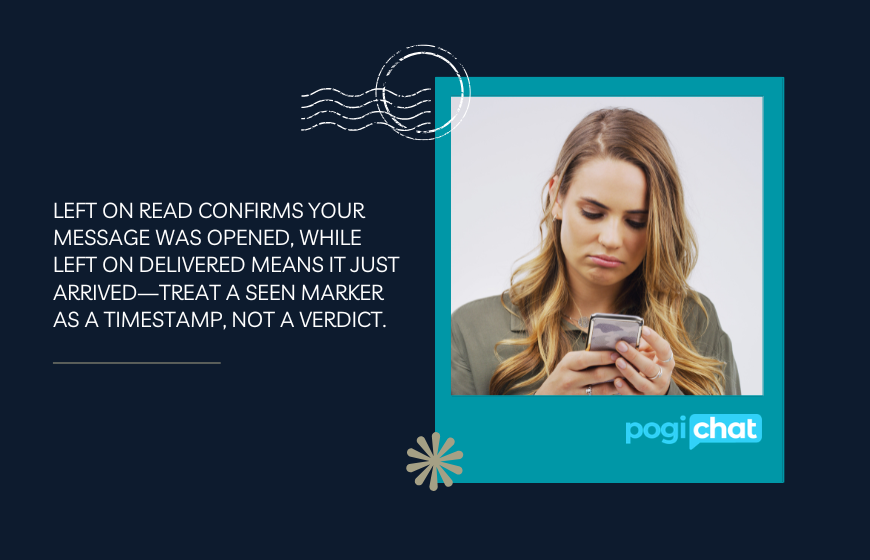
Left unread is the same silence with a plainer cause, because the message was never opened. Some sites show a seen marker and others don’t, so identical behavior can look different from one platform to the next.
Picture a Friday message to a match about the trail photo in their profile. It shows as seen at 8:40 p.m. and gets no answer until Sunday. Nothing in that gap shows if they were out, busy with other chats, or losing interest, and the app can’t tell you either. I’d treat the seen marker as a timestamp, since only one of those three explanations is bad news.
Why Does Being Ignored Hurt So Much?
According to Purdue’s 2011 release, ostracism is an “invisible form of bullying” whose pain is often deeper and longer-lasting than a physical injury. More than 5,000 people took part in studies using Williams’s computer game, and two or three minutes of being ostracized produced lingering bad feelings. Even strangers caused harm, and the effect held across personality differences.
The brain area that registers physical pain, the dorsal anterior cingulate cortex, also registers social injury. Williams’s studies weren’t about texting, so treat them as an explanation of the hurt, not proof about any single message.
I read the findings this way: if a few minutes of being ignored by strangers leaves a mark, a match you were warming to going quiet can reasonably land harder, and the reaction doesn’t mean you’re oversensitive.
READ MORE:
What Andrew Huberman Teaches About Feelings and Relationships
Toxic Relationship Signs: What Psychology Says It Looks Like
Why Do Women Sit Separately at Filipino Gatherings?
What Happens in Your Head After a Message Shows as Seen?
Purdue’s 2013 announcement of Williams’s talk on a temporal model of ostracism names four needs: belonging, self-esteem, control, and meaningful existence. The 2011 release describes the sequence as initial exclusion, coping, and resignation, while the 2013 page labels the stages reflexive, reflective, and resignation. In dating terms, I’d translate the four needs like this:
- Belonging: the feeling that the conversation was going somewhere shared.
- Self-esteem: the replay of your last message to find the flaw.
- Control: nothing you send can force an answer.
- Meaningful existence: feeling like a profile that was viewed and dismissed.
Coping comes next. According to the 2011 release, some people try harder to be included, while those with little hope of being included again may turn provocative or aggressive. On a dating site the first path looks like a cheerful third message or sudden agreement with opinions you’d normally question. The second looks like a sharp “fine, never mind.”
Neither is likely to improve your odds of a reply, and both give up the calm that made you attractive in the first place.
The same release links resignation to more anger and sadness, along with helplessness and feelings of unworthiness. A single unanswered message sits at the first stage, not the third, which is a good reason to stop chasing a string of silent matches early.
What Should You Send, and What Should You Skip?
My rule of thumb is to wait 48 hours before doing anything, since that clears an ordinary busy weekend. If the silence continues, send one light follow-up that adds something new, such as a question about a detail they mentioned earlier. Skip any message about the silence itself. “Why are you ignoring me?” asks the other person to defend themselves, which rarely feels inviting.

Chat with strangers
from around the world
Random, anonymous, and instant — no sign-up required. Just click and start talking.
After that, move your attention to someone else, such as a match who already replies. Control is one of the four needs Purdue’s 2013 page names for Williams’s model, so spending effort where you can influence the outcome is a sensible counterweight. If you’re the one leaving people on read, a short “I don’t think we’re a match, good luck” costs half a minute and spares them the guessing.
Where a Seen Message Leaves You
Left on read means a message was opened and went unanswered, and the hurt that follows matches what Williams’s research describes for being ignored, so it isn’t a sign of fragility. His work covers ostracism broadly, and one of its methods was a computer game, so it explains the feeling but cannot tell you why one person went quiet.
If unanswered messages are leaving you low for weeks, talking with a counselor or therapist is a reasonable step. Before your next send, write down a follow-up window, such as 48 hours, because a rule set in advance is easier to follow than one invented mid-worry.
Frequently Asked Questions
What Does Left on Read Mean?
It means the other person opened your message, the app marked it as seen, and no reply came. The term describes the situation only, so it says nothing about why they haven’t answered.
Is Left on Read the Same as Left Unread?
No. Left unread means the message was never opened, while left on read means it was. Left on delivered sits between them, since the message arrived but there’s no sign it was opened.
Why Does Being Left on Read Hurt So Much?
According to Purdue’s 2011 release on Kipling Williams’s research, ostracism can cause pain deeper and longer-lasting than a physical injury. Even a few minutes of exclusion by strangers left lingering bad feelings in his game studies.
How Long Should You Wait Before Following Up?
My rule of thumb is about 48 hours, which covers a busy weekend. Send one light message with a new question, then stop and give your attention to matches who respond.
Does Being Left on Read Mean They Aren’t Interested?
Not necessarily. A seen marker shows the message was opened, not why there was no answer. They could be busy, overwhelmed by other chats, or uninterested, and the marker can’t tell those apart.