
 By Keven Galolo
Key Takeaways
- Treat emotions as three dials: energy, mood quality, and attention.
- Name your feeling precisely before you react to it.
- Remember that childhood bonds influence you without controlling you.
- Ignore quick-fix hormone and nerve hacks.
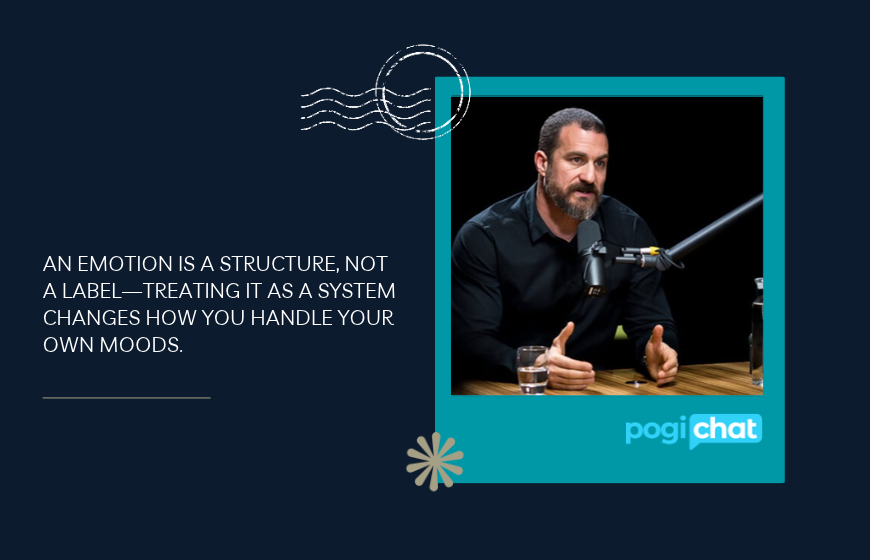
I used to answer “how are you?” with one word. Fine. Stressed. Tired. That single word hid everything useful. When I watched Andrew Huberman’s Essentials episode on emotions and relationships, it changed how I read my own moods. The Stanford neuroscientist treats an emotion as a structure, not a label. That idea is the heart of the science of emotions, and it matters most in close relationships, where our feelings collide with someone else’s. He also admits he is not a therapist, so treat it as education, not treatment.
Huberman’s Three Dials
Huberman says emotions are complicated but understandable. He breaks nearly every feeling into three dials.
1. Check Your Energy
Arousal is how alert or calm you are, from 1 to 10. Notice it before a hard conversation. A 9 and a 3 handle the same news very differently.
2. Check Your Mood
Valence is simply how good or bad you feel. Pair it with energy and you get a map. The Yale-built Mood Meter plots energy against pleasantness on a four-color grid, and I like that it bans vague words like “fine.”
3. Check Your Focus
Attention points inward (what your body feels) or outward (what’s around you). Anxiety pulls it inward fast. Try this: feel your breathing for ten seconds, then study one object. Notice how hard the switch is.
How Early Bonds Shape You
Babies cannot read the world yet, so every unmet need feels like anxiety. Huberman’s point is that crying and a caregiver’s response teach us to predict if people can be trusted. I think this is the most useful idea in the whole episode.
Researchers tested it in the Strange Situation experiment. They watched how infants reacted when a caregiver left and returned, then sorted them into four patterns: secure, avoidant, ambivalent, and disorganized.
Translate it to adult life. After a fight, do you move toward your partner, withdraw, or swing between both? I tend to withdraw, which I only noticed after naming it. None of that is destiny. It’s a pattern, and patterns can be noticed.
Puberty is the second big rewiring. Huberman explains that brain changes start first, then hormones follow, and teens begin testing who they can rely on. That explains a lot of teenage drama, and honestly, a lot of adult drama too.
READ ALSO: How to Meet People in Real Life & Build Genuine Connections
Bonding Chemistry Without the Hype
Hormones get oversold online. I’d treat each one below as a clue, not a cheat code.
Oxytocin and Closeness
In one 2009 lab study, couples who received oxytocin showed more positive communication and lower cortisol during a conflict talk. That is intriguing. The authors still say it isn’t a treatment, and I agree: closeness comes from behavior, not a nasal spray.
Vasopressin and Pair Bonds
Huberman also covers vasopressin, which shapes monogamy in prairie voles. Human evidence is thin, so I’d skip any dating advice that rests on it.
The Vagus Nerve Myth
You’ve probably heard that vagus nerve stimulation always calms you. Huberman says that’s a myth: it’s more about alertness. Be wary of any gadget that promises instant calm.
A Simple Daily Practice
Frameworks only help if you use them. Try this three-step check once a day.
- Rate: Score your energy and mood from 1 to 10.
- Name: Pick one precise word, not “fine.”
- Aim: Decide if your attention should go inward or outward.
I do this before replying to a stressful message. It takes thirty seconds and has saved me from more bad texts than I can count. Do it when you’re calm, too, so the skill is ready when you aren’t.
The science of emotions is not about controlling every feeling. It’s about reading them. Huberman’s three dials give you a vocabulary: how much energy you have, how good you feel, and where your attention sits. Add your own history with people, and your reactions start to make sense. You don’t need a perfect childhood or a perfect partner for that. You need a daily habit of noticing.
Be curious, not harsh, with yourself. And remember that this is education, not therapy. If your feelings feel too big, a licensed professional can help. Start today with one honest word. Then check in again tomorrow.

Chat with strangers
from around the world
Random, anonymous, and instant — no sign-up required. Just click and start talking.
FAQs
What are the three parts of an emotion?
Energy (alert versus calm), mood quality (good versus bad), and attention (inward versus outward). Huberman argues most feelings blend all three, so a single label misses detail.
What is the Strange Situation experiment?
It is a lab test where researchers watch how an infant reacts when a caregiver leaves and returns. It sorts babies into four attachment patterns, and it is a research tool, not a diagnosis.
Can attachment patterns change?
Yes. Early patterns are a starting point, not a verdict. Noticing how you react in close relationships is the first step toward responding differently.
Is oxytocin the trust hormone?
It plays a role in bonding, but the label oversells it. The 2009 couples study found helpful effects during conflict, yet its authors say oxytocin is not a treatment.
Does vagus nerve stimulation always calm you?
No. Huberman says it relates more to alertness. Medical implants help some people with severe depression, but they are surgical treatments prescribed by doctors.