
 By Keven Galolo
Key Takeaways
- Treat AI couples therapy as a between-session coach, not a therapist replacement.
- Avoid general chatbots for fights, because they hear one side and tend to agree.
- Pick a tool that names your cycle, not one that only gives tips.
- Skip AI if abuse, coercive control, addiction, or a crisis is involved.
Late at night, one of you opens a chatbot, types out the whole argument, and gets back an answer that sounds wise and sympathetic. I get why that’s tempting, but a tool that has heard only one side should make you wary. Figs O’Sullivan, a licensed couples therapist with 17 years of practice, tackles that question directly in his guide to AI couples therapy. He works with Emotionally Focused Therapy, built an AI coach of his own, and says openly that he’s biased. His framework is still worth borrowing, so below are where AI helps, where it fails, and a routine for tonight.
The Cycle Behind Your Arguments
O’Sullivan’s central idea is that conflict sets off an alarm in the nervous system, and each person quietly asks if their partner is there for them and if they are enough. One partner pushes for contact while the other pulls away, and he calls that loop the pursue-withdraw cycle.
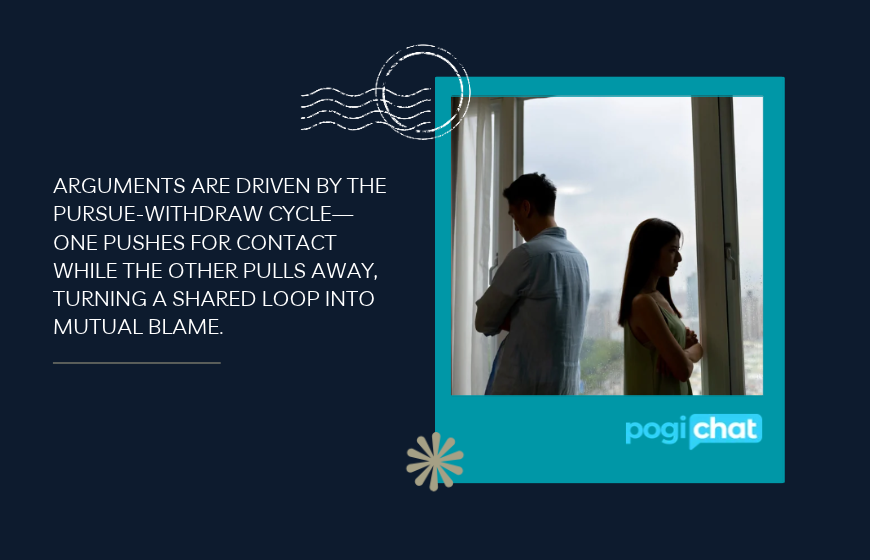
His own assessment backs the pattern: among 6,159 couples in which both partners finished it, 74.1% were caught in this cycle. That data comes from his company’s tool, so I’d read it as a strong hint, not proof. It still helps, because blaming your partner’s personality feels different once you see you both keep the same loop running.
Three Kinds of AI Tools
O’Sullivan sorts AI couples therapy into three categories, and the category matters more than the brand name. A free chatbot, a purpose-built coach, and a therapist’s own assessment tool can all be called AI couples counseling, yet they behave very differently in the middle of a fight.
General Chatbots
These tools hear one side, lean toward agreeing with you, and know nothing about your history as a couple. O’Sullivan ranks them weakest for an active fight, so keep them for low-stakes jobs like drafting a calmer message.
Specialized Coaches
These tools rest on a clinical method, assess your patterns, and name the pursue-withdraw loop. O’Sullivan says weaker versions send only daily prompts and tips. His checklist asks for licensed clinicians behind the tool, a clear privacy policy, honest limits, and a path to a human clinician.
Therapist-Led Tools
Some therapists add AI through pre-session assessments or coaching between appointments, and O’Sullivan considers this the strongest use. He also claims a well-built coach can beat the average therapist on consistency, but he offers no evidence, so I’d treat that as marketing, not fact.

Chat with strangers
from around the world
Random, anonymous, and instant — no sign-up required. Just click and start talking.
Why Chatbots Take Your Side
O’Sullivan calls the core problem with general chatbots the mirror problem. He describes a wife who asked AI to explain her husband’s divorce request and received an account that reflected only her own view. The chatbot had no way to question her husband, so it polished her version of events instead of testing it.
Stanford researchers tested 11 AI models, including ChatGPT, Claude, and Gemini, and found that the models endorsed users 49% more often than people did on advice prompts. That gap matters in a couple’s fight, because agreement feels like support while it quietly hardens your side.
People in the same research who chatted with agreeable bots became more convinced they were right and were less likely to apologize. They also rated agreeable and neutral bots as equally objective, so you probably can’t feel the bias while it’s happening. If you use a chatbot at all, I’d ask it to argue your partner’s side first, and never paste its verdict into a message to your partner.
Where AI Must Step Back
O’Sullivan lists domestic violence, coercive control, acute mental health crises, active addiction, and severe trauma in either partner as points where AI should hand off. He also leaves betrayal work, such as recovery from infidelity, to a human therapist who can adjust when a session turns unpredictable.
The law is moving the same way. Illinois has barred AI from communicating therapeutically with clients since August 2025, though licensed professionals can still use it for scheduling and records. O’Sullivan says California and Nevada have similar limits but cites no source, so check your own state.
READ MORE: 5 Best AI Companion Apps in 2026 (Virtual Friends & AI Chat)
A Tonight Routine to Try
O’Sullivan’s routine is meant for the minutes before you say something you can’t take back. Timing matters, because a six-year study predicted divorce from the first three minutes of a conflict talk.
- Ground in your body: Slow your breathing and drop your shoulders so your nervous system stops treating the argument as an emergency.
- Name the sensation: Admit the comment landed, then notice where it hits, such as a tight chest or hot face.
- Ask who is typing: Check if the part of you drafting the reply wants to be understood or wants to be right.
- Send one true sentence: Give your partner one honest line in your own words and leave out any verdict.
I’d run this for two weeks and watch for shared language for the cycle, slower fights, and a partner who looks afraid more than hostile.
AI couples therapy works best as a coach that helps you see your cycle and practice new responses, not as a substitute for a therapist. O’Sullivan admits there are no long-term, peer-reviewed trials that compare AI-only coaching with human therapy, so treat his enthusiasm and his company’s numbers with some caution.
Start small: tonight, write one honest sentence to your partner in your own words and see how it lands.
FAQs
Does AI Couples Therapy Work?
Partly. O’Sullivan says purpose-built tools can help you see your cycle between sessions, but they can’t match a skilled therapist, and no long-term trials compare the two.
Is ChatGPT Good for Couples Counseling?
Not for fights. General chatbots hear one side and lean toward agreeing, so use one only to draft a calmer message, not to judge who’s right.
Is AI Couples Counseling Safe?
It isn’t safe for abuse, coercive control, active addiction, severe trauma, or an acute crisis. In the US, call or text 988 or call 911.
Can AI Help After Infidelity?
O’Sullivan places betrayal work with a human therapist. An AI coach might help you calm down and plan what to say, but healing needs someone who can read the room.
What If Your Partner Won’t Try It?
O’Sullivan suggests the pursuing partner learn their own pattern and share it as self-awareness, not blame. He advises against pressuring your partner.