
 By Keven Galolo

Key Takeaways
- Ghosting ends contact without explanation; a fade out lowers effort over weeks first.
- The one who gets left feels worse than the one who leaves, either way.
- Treat commitment, not breakup method, as the bigger driver of distress.
- Send one clear closing message; it removes the guessing a fade creates.
Your match used to reply within the hour. Now answers take two days, run one line long, and never ask a question back. Is that a fade out or ghosting, and does the label change what you should do? I think people blur the two terms because both feel like rejection without the words. Rebecca Koessler, Taylor Kohut, and Lorne Campbell of the University of Western Ontario rana pre-registered study of 595 adults after recent breakups. The paper appeared in Collabra: Psychology, a peer-reviewed journal. Below you’ll find the definitions that matter, who the data says gets hurt, and a way to read silence on a text-only dating site.
What Is the Difference Between a Fade Out and Ghosting?
Koessler’s team defines ghosting as a breakup that happens through silence, with no statement that it’s over, so the other person has to guess what the quiet means. A fade out follows the same logic over a longer stretch. According to Miller, quoted in Women’s Health, a fade out is a gradual withdrawal of communication and effort in dating, and casual cases can take two to four weeks.
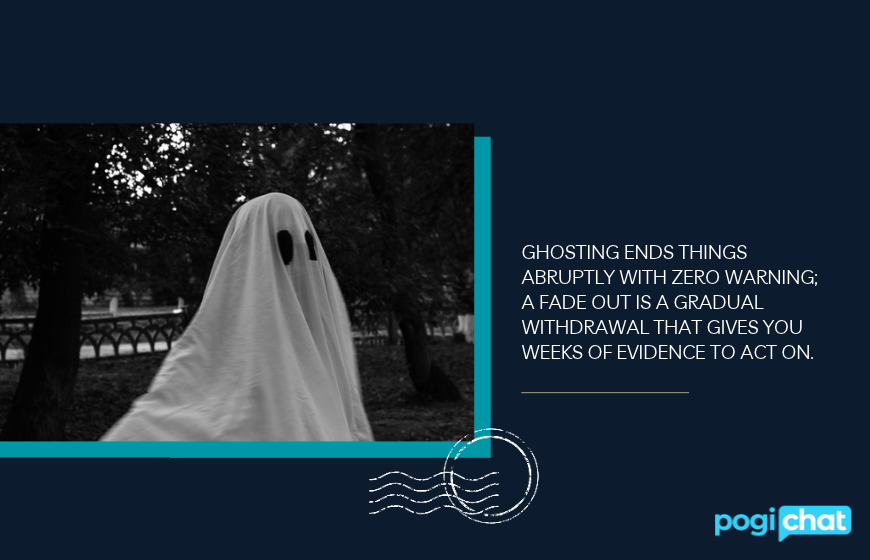
The paper concedes that ghosting can unfold gradually or all at once, so by the authors’ account a fade is one version of ghosting. I still keep the terms apart, because a fade gives you weeks of evidence to act on and ghosting gives you none.
What Did the Study Compare?
The team crossed two variables: whether you ended things or got left, and whether the ending was ghosting or a direct conversation. That produced four groups of about 150 people each. One half of the data was used to explore, and the other half tested 15 pre-registered hypotheses, and eight held up. That replication step matters because it screens out patterns that appeared by chance. Participants were 595 adults between 18 and 35 in the United States and Canada. They came from Amazon’s MTurk and described a breakup from the past six months. Treat the findings as reliable on direction but looser on exact size, since everyone reported from memory.
Who Gets Hurt More, the Ghoster or the Ghosted?
People who got left reported more distress and negative emotion than people who did the leaving, and that gap held in both halves of the data with large effects. Breakup method mattered less: in exploratory analyses, direct breakups looked more distressing than ghosting, but the difference disappeared once the researchers accounted for how committed people had been.
The authors conclude that being the rejected partner, without control over the ending, mattered more than how the ending happened. The evidence is not unanimous, though: a 2022 study found that ghosting led to worse outcomes than rejection among 176 people. I’m skeptical of any post that calls ghosting the worst way to get dumped. If you’re the one left, set your own deadline for a reply, because choosing the endpoint returns some of the control the study links to distress.

Chat with strangers
from around the world
Random, anonymous, and instant — no sign-up required. Just click and start talking.
Why Does a Fade Out Feel So Confusing?
Consultant psychologist James Bosse says a fade prolongs uncertainty, because you never learn where you stand. In his view, a fade moves you back and forth between hope and disappointment, which feeds anxiety and self-doubt. His test for telling a fade from a busy week is whether the person reconnects with a new plan, because busy people usually do and disengaged people rarely try.
Koessler’s data adds a second source of confusion. People who ghosted rated losing interest as a stronger motive than the people they ghosted believed, and that gap held in the pre-registered half. So the explanation you invent for the silence, such as stress or bad timing, is probably kinder than the one the sender would give. If a thread cools, ask once, calmly, and treat a missing plan as your answer.
How Should You Read Silence on a Text-Only Site?
When text is the only channel, typed replies are all the evidence you have. Koessler’s team found that ghosting breakups involved more avoidance and withdrawal and far less open confrontation, which fits a thread that goes silent. The paper cites Freedman and colleagues, who found people judge ghosting as more acceptable after two dates or fewer, or before physical intimacy. That helps explain why early silence on dating sites feels normal.
Do not stretch that into a rule, though, because ghosted relationships in Koessler’s samples averaged about six months, with commitment above the scale midpoint. I’d rather get two honest lines than a fade, and the paper makes that cheap, since a one-line text that says it’s over counts as a direct ending.
READ MORE:
Oxytocin and Texting: Does a Text Really Trigger Attachment?
Why Text Chatting Without Video Is Still Relevant Today
Why We Fall for Text Messages Faster Than Real People
Choose a Clear Ending
Fade out vs. ghosting comes down to speed: ghosting cuts contact at once, a fade lowers effort over weeks, and neither says it’s over. The study found the person who gets left hurts more either way, and commitment predicted distress better than method. Limits apply: participants self-reported, were 18 to 35, and lived in North America, and the distress comparisons were exploratory. Bosse’s and Miller’s advice is expert opinion, not a diagnosis of motives, and a counselor can help if a silence keeps you anxious for weeks. Write a one-line closing message now and send it when interest fades, because one clear text counts as a direct ending and gives the other person closure.
FAQs
What Does Fade Out Mean in Dating?
It means a gradual withdrawal of communication and effort that ends a connection without a definitive break. According to Miller in Women’s Health, casual cases might take two to four weeks.
Is a Fade Out Worse Than Ghosting?
The evidence is mixed: Bosse says a fade prolongs uncertainty, a 2022 study found ghosting worse than rejection, and Koessler’s team tied distress more to commitment and breakup role than to method.
Is It Okay to Fade Out on Someone?
Freedman and colleagues, whom Koessler’s paper cites, found people judge ghosting as more acceptable after two dates or fewer. As commitment grows, a direct message fits better, since commitment mattered more than method for distress.
Does Ghosting Only Happen in Short Relationships?
No, Koessler’s team found ghosted relationships were shorter and less committed on average, yet they still lasted about six months, with commitment above the scale midpoint.
Does Being Faded Out Say Something About Your Worth?
Bosse says a slow fade reveals more about the other person’s ability to handle discomfort than about your worth. He recommends self-compassion, calm questions, and no chasing.